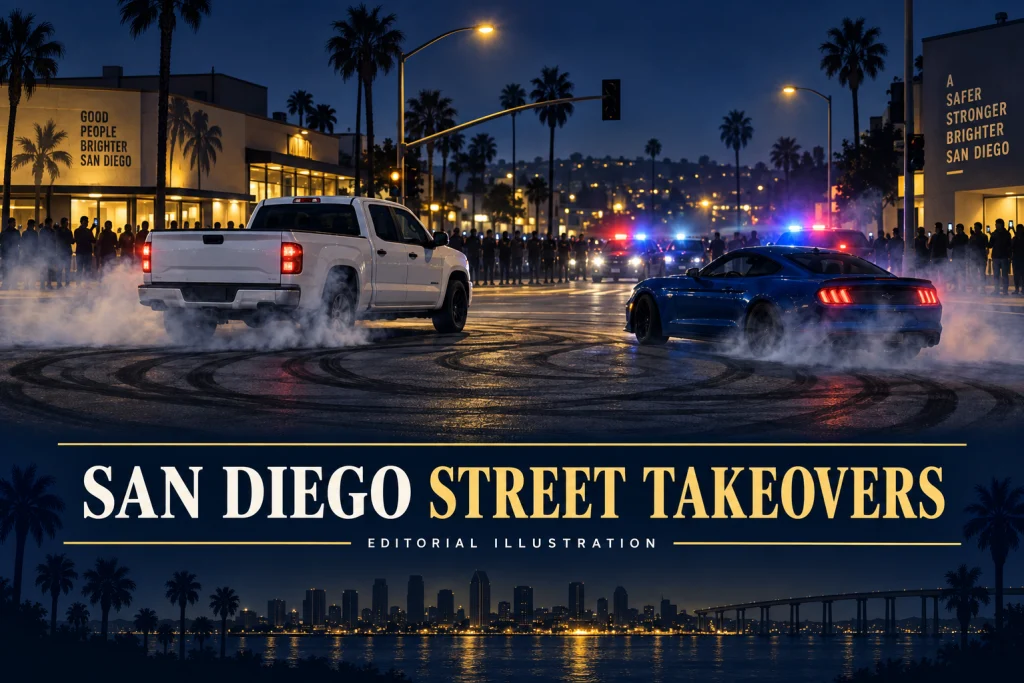
San Diego Street Takeover: Arrests and Legal Consequences
A
San Diego street takeover investigation led to arrests after police tracked activity through social media. The case highlights how driving stunts can lead to allegations of reckless driving, vandalism, and evading police.According to SDPD’s August 12, 2026 release, officers worked with the California Highway Patrol during an August 8 operation. Investigators tracked a group coordinating takeovers across several intersections.In Scripps Ranch, police said Joshua David Ruiz, 18, participated in a rented U-Haul pickup. Officers arrested him on suspicion of felony vandalism, exhibition of speed, and reckless driving.Police also identified Jesus Arias-Ruiz Jr., 27, as a participant driving a blue BMW M4. They alleged that he fled above 100 mph and switched off his vehicle’s lights.Officers ended the ground pursuit for safety while a helicopter continued tracking. Investigators arrested Arias-Ruiz on August 10. His booking allegations included felony evading and vandalism.Authorities estimated roughly $5,153 in roadway damage from the sideshow. These are police allegations, not findings of guilt. Read the
SDPD enforcement announcement.
Watch the linked NBC 7 San Diego coverage.What Charges Can Follow a Street Takeover?
“Street takeover” describes an event rather than one universal criminal charge. Prosecutors must identify the specific conduct and prove the elements of each alleged offense.Consequently, two people at the same gathering may face different allegations.
Exhibition of Speed
California Vehicle Code section 23109 prohibits motor vehicle speed contests and exhibitions of speed. It covers highways and offstreet parking facilities.An exhibition of speed can lead to a misdemeanor charge. However, officers must connect the driver’s conduct to the legal requirements of the offense.The statute also addresses aiding these activities and placing obstructions to facilitate them. Therefore, potential liability can extend beyond the person behind the wheel.
Reckless Driving
Vehicle Code section 23103 defines reckless driving through willful or wanton disregard for the safety of people or property.The distinction matters because careless driving and criminal recklessness are not automatically the same.For example, an attorney may examine the vehicle’s movements, nearby traffic, and the surrounding conditions. Those details help assess whether prosecutors can prove the required disregard for safety.
Vandalism
Penal Code section 594 addresses malicious damage to someone else’s property.Damage of $400 or more can support felony treatment. However, the offense can qualify as either a misdemeanor or felony, depending on the case.A repair estimate alone does not prove every element. Prosecutors must also establish the defendant’s responsibility and the required mental state.Therefore, a defense review may examine photographs, repair records, preexisting damage, and evidence connecting the driver to the damage.
Evading Police With Disregard for Safety
Vehicle Code section 2800.2 concerns fleeing a pursuing officer while driving with willful or wanton disregard for safety.This offense can receive misdemeanor or felony treatment. Lawyers often describe that classification as a “wobbler.”However, high speed alone does not establish every element. Prosecutors must also prove the requirements of the underlying evading offense.An attorney should therefore review the pursuit evidence and the circumstances surrounding the attempted stop.
Can Organizers or Spectators Face Charges?
Someone does not always need to drive to face criminal allegations connected to a takeover.For example, section 23109 prohibits aiding or abetting speed contests and exhibitions of speed. It also prohibits certain acts that obstruct roads or parking facilities to help those activities.However, filming an event or posting a video does not, by itself, establish those offenses. Investigators must distinguish observation from conduct that meets the applicable legal requirements.Likewise, a large social media following does not prove criminal participation. Prosecutors need evidence connecting the person’s actions and intent to the alleged offense.Local rules may also affect a particular case. Therefore, an attorney should identify the exact law behind any spectator or organizer allegation.
How Can Social Media Videos Become Evidence?
Public posts can give investigators leads. However, a video’s popularity does not establish its accuracy or prove who drove a vehicle.A careful review should ask:
- Does the footage clearly identify the driver?
- Does it show the correct location and date?
- Is the recording complete?
- Does the clip omit important events?
- Who created or uploaded the original file?
- What other evidence supports the interpretation?
Also, reposts may lose information from the original recording. Captions and comments may reflect assumptions rather than firsthand knowledge.For these reasons, the defense should examine the source and context of each clip. Courts must still apply the relevant evidence rules.
Does a Street Takeover Allegation Mean DUI?
No. Reckless driving and exhibition of speed do not automatically establish impairment.The legal analysis must match the actual allegations and evidence. A driver’s participation in a stunt does not, by itself, prove alcohol or drug use.Therefore, families should review the booking information and any filed complaint rather than assume that every traffic-related arrest involves DUI.
What Should a Defense Attorney Review?
A San Diego street takeover case may involve several separate factual disputes. An attorney can begin by identifying the precise allegations against the client.The review may then focus on:
- Identity: What evidence shows who drove or organized the activity?
- Conduct: Does the evidence support each element of the alleged offense?
- Damage: How did investigators calculate the repair amount?
- Video evidence: Is the footage complete and properly connected to the incident?
- Police pursuit: What happened during the attempted stop and subsequent driving?
In addition, ask about any vehicle hold or potential license consequences. The applicable process depends on the alleged offense and legal basis.For background, read our guide to
street racing and exhibition of speed defense.
What Should You Do After an Arrest?
First, keep your paperwork and note every court date. Provide those documents to your attorney.Also, preserve original videos, messages, photographs, and relevant account information. Avoid deleting or altering potential evidence.Write down what you remember while the details remain fresh. Include the location, timing, witnesses, and any interaction with officers.Finally, discuss the allegations with counsel before posting a public explanation. A short online response may leave out context or create additional disputes.
Facing Street Takeover Charges in San Diego County?
An arrest connected to a street takeover can involve more than a traffic citation. The specific allegations may require separate reviews of driving conduct, property damage, and police pursuit evidence.The
Law Offices of David S. Chesley serves clients in San Diego County. Contact the firm for a free consultation about reckless driving, exhibition of speed, or related criminal allegations.Call
(800) 755-5174 to discuss your situation.
This article provides general information, not legal advice. Arrest and booking allegations do not establish guilt. Every case depends on its facts and applicable law.